
EEF Guide to Inclusive Teaching

In July 2026, the Education Endowment Foundation (EFF) published its Guide to Inclusive Teaching, containing advice about supporting every child to participate and succeed in school, including disadvantaged pupils, those with SEND and those facing multiple barriers to learning.
School leaders and classroom teachers across mainstream primary and secondary schools are the principal intended audiences for the guide. Drawing on a wide range of evidence about effective inclusive education and classroom practice, the guide aims to support schools in developing their inclusion strategy, and to embed effective inclusive practice.
The guide is built around a two-part model of inclusive teaching:
- Universal approaches that are likely to be especially important for pupils with additional needs.
- Adaptations and additional support that might also be needed by some pupils.
These are explored in the guide through three Key Questions.
1. What do we do every day that is especially important for pupils with additional needs?"Strengthening and sustaining universal practices that are especially important for pupils with additional needs is likely to benefit all pupils and reduce – though not remove – the need for adaptations or additional targeted support. This question also reflects the idea that to a great extent good teaching for pupils with additional needs contains the same elements as good teaching for all. A starting point for improving inclusive teaching is focusing on doing those fundamentals consistently well.” |
2a. What adaptations or additional support might also be needed by some pupils?2b. How do we know that they help rather than hinder learning?“Pupils can benefit from different types of additional support, including one-to-one or small group interventions delivered by teachers or teaching assistants and specialist support delivered by external experts, as well as from classroom adaptations made by teachers. For some pupils, adaptations and additional support might only be needed for a short time, while for others they may be needed on an ongoing basis. It is important to recognise that adaptations and additional support can be effective or ineffective, and that ineffective support or adaptation can hinder learning….it is essential to monitor the impact of adaptations and additional support carefully and not assume positive effects on learning.” |
The Universal Approaches section focuses on:
- Explicit Instruction
- Feedback
- Scaffolding
- Positive Relationships
- Calm Classroom Environments
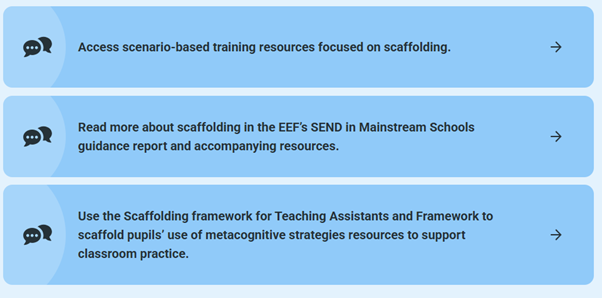
General summary guidance is provided under each heading, along with direct links to additional guidance and training materials. For example, the following are provided to support Scaffolding:
Supporting the second part of the two-part model, Adaptations and Additional Support focuses on:
- Classroom adaptations
- Support for Teaching Assistants
- Selecting targeted interventions
- Using Technology
The same format of general guidance and links to further guidance and training support is used.
 The leadership-focused Implement, Monitor and Sustain section draws mainly on the EEF School’s Guide to Implementation guidance report.
The final section, Inclusive Teaching Myth Busting, addresses 5 key ‘myths’ around inclusive teaching practice:
- Inclusive teaching is all about what schools do differently for pupils with additional needs.
- The more adaptations teachers make, the more pupils will learn.
- Interventions are the most important way to support pupils with additional needs.
- If a pupil has a diagnosis, we automatically know the best way to support them.
- Teachers need specialist expertise before they can effectively support pupils with additional needs.
Each of these could provide an interesting starting point for professional discussion.

The Resources, Tools and Supporting vidence provided are extensive. Schools may find the new ScenarioSpace area particularly useful, as it provides linked scenario-based professional development sessions of 30–45 minutes, supported by a Facilitation Guide and links to underpinning evidence.
This new guidance is particularly timely, given the requirement for mainstream schools to develop and publish their Inclusion Strategy as part of the Inclusion Mainstream Fund grant by December 2026.