
EEF Guidance Report: SEN in Mainstream Schools
DfE statistics on pupils with SEN document the year-on-year increase in the number of pupils with special educational needs. Meeting the needs of these pupils presents a significant, and increasing, challenge for schools. It is not surprising, therefore, that the EEF Special Education Needs in Mainstream Schools Guidance Report is currently one of the most frequently accessed documents on its website.
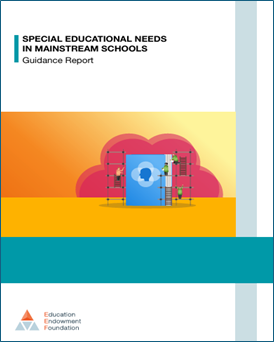 The report follows the now familiar format :
- Introduction
- Summary of recommendations
- Expansion of each recommendation, including school case studies and links to other EEF resources
- References and methodology
Language matters— ‘Pupils are SEND’
“It is not helpful to say that a pupil ‘is SEND’ or ‘there are SEND pupils in our class’, and this language may undermine efforts to establish and maintain high expectations for the learning of all pupils. It is more helpful to say pupils ‘have SEND’ or ‘there are pupils with SEND’ within a class. SEND is not a fixed or permanent characteristic; it is a recognition that at a specific time a child has additional learning needs. At times, many pupils will require tailored or additional support to fully participate in everything the school has to offer.”
Introduction to SEN in Mainstream Schools Guidance Report
The more recent online version Special Educational Needs in Mainstream Schools summarises each of the recommendations, and in the resources section provides access to the full report, the summary poster of the 5 recommendations, and additional tools.
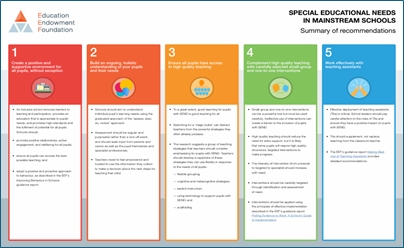 The additional tools focus on two key principles:
- ‘Every school leader is a leader of SEND’ – this resource contains ‘questions for reflection’ for school leaders (including governors) linked to the 5 key recommendations.
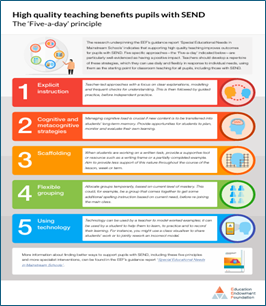
- ‘Every teacher as a teacher of SEND’ – a tool to support teachers to reflect on how consistently they embed into their practice the 5 core adaptive teaching strategies defined within the report as the ‘Five-a-day’ strategies.
 The refreshed EEF website also makes it easier to identify and access additional related reading and support tools in the ‘More to discover’ section (open the report on the EEF website and scroll down to the bottom of any page).
These include, among others:
- Core principles for Selecting interventions for pupils with SEND.
- An episode of the EEF Evidence in Action podcast focusing on ‘SEN in Mainstream’.
- The updated EEF Deployment of Teaching Assistants Guidance Report (see our Spotlight on Evidence post from June 2025).
- Guidance on the ‘5 a Day’ adaptive teaching strategies.
This suite of materials and guidance is just one example of how the EEF website, particularly in its refreshed format, supports schools, colleges, and early years settings “to make a difference with evidence”.
Read our other Spotlight on Evidence articles here.